A business license Pennsylvania requirement depends on what your business does, its legal structure, and every municipality where it operates. You may need several registrations or permits rather than one statewide license.
Key Takeaways
- Pennsylvania does not require every business to obtain a general statewide business license.
- Your activity, profession, location, premises, and tax obligations determine which approvals you need.
- Use the Pennsylvania Business Hub's online tools, then verify the results with the responsible agency and municipality.
- An LLC, EIN, or DBA does not replace a business license or permit.
- Local governments may require a business privilege license, zoning approval, or other operating permits.
- Fees, application methods, and renewal dates vary by issuing authority.
Business License Pennsylvania Requirements: Do You Need One?
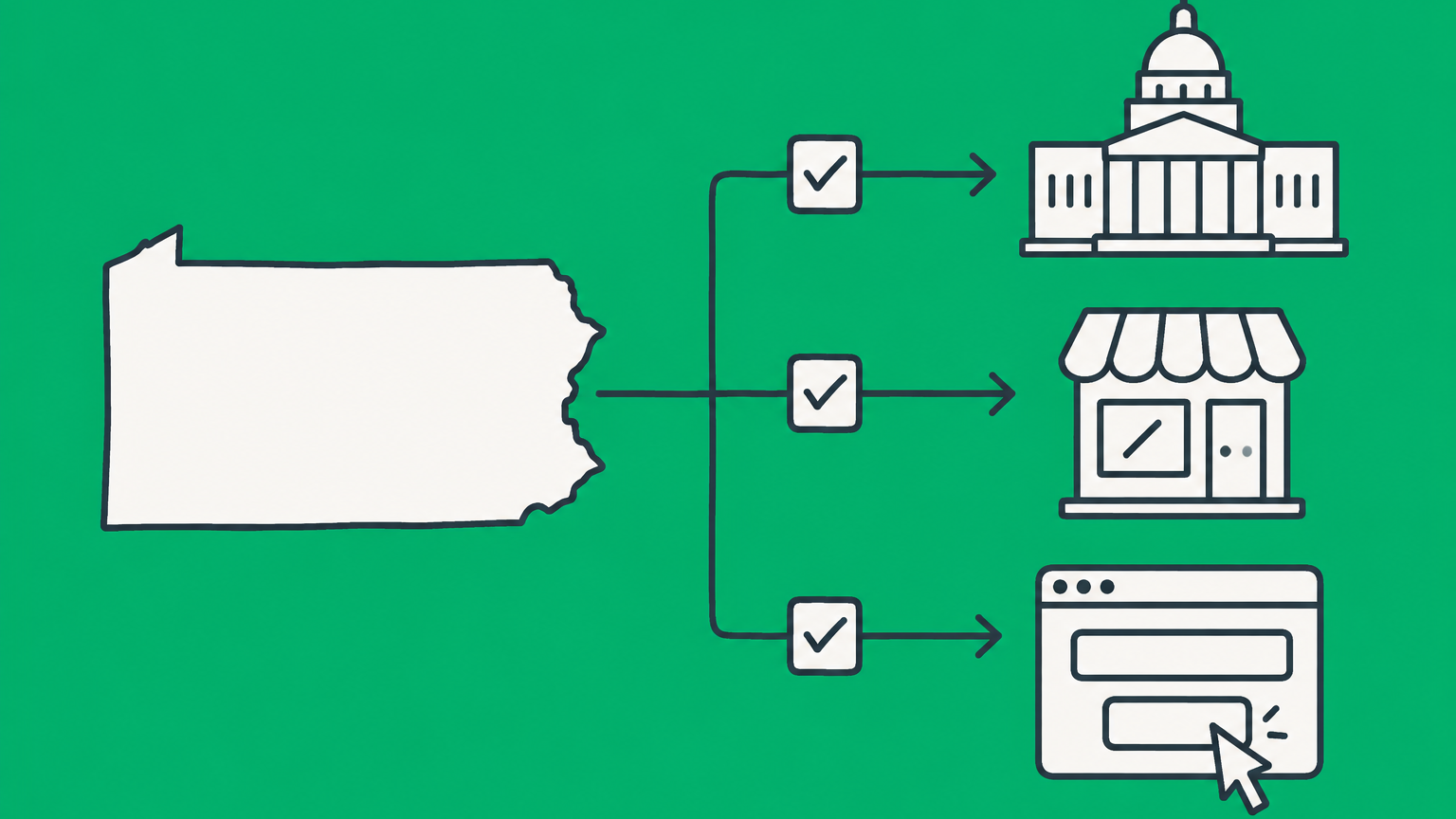
Pennsylvania does not have a single general business license that applies to every company. Instead, the state and its municipalities regulate particular activities, professions, tax obligations, and uses of property. A consultant working from home may face different requirements than a restaurant, contractor, retailer, childcare provider, or manufacturer.
Start by asking four questions. What products or services will you provide? What legal structure will you use? Where will you perform the work? Will customers visit a physical location? Your answers may trigger state tax registration, professional licensing, local business registration, zoning approval, health permits, building permits, or other specialized approvals.
A license generally authorizes an activity or occupation. A permit often authorizes a particular use, project, facility, or installation. Registration may establish a legal entity, record a business name, or create a tax account. These categories can overlap, but completing one does not automatically complete the others.
Confirm requirements before signing a lease, renovating a property, buying regulated equipment, or advertising a regulated service. A municipality may restrict a proposed use even when the business has completed its state filings. Operating without a required approval can lead to delays, citations, added expense, or an order to stop the affected activity.
How to Get a Business License in PA Online
There is no universal Pennsylvania business license form. Applying for a business license starts with identifying the government office responsible for each required approval. Use this process:
- Describe the business activity. List each product, service, regulated occupation, and physical location. Include secondary activities such as selling merchandise, serving food, installing signs, or storing regulated materials.
- Use the official state lookup. Visit the Commonwealth of Pennsylvania Business Hub and use its QA Wizard or business registration tools. Answer the questions carefully to generate a starting checklist of registrations, licenses, permits, and agencies.
- Check the responsible state agency. Verify professional and occupational licensing through the Pennsylvania Department of State. Other regulated activities may fall under a different state department or board.
- Review tax registrations. Use the Pennsylvania Department of Revenue for current business tax registration instructions. Do not rely on an old PA-100 reference without checking the department's current online system.
- Contact each municipality. Check the official city, borough, or township website for local licenses, business tax accounts, zoning, occupancy, building, signage, health, and fire requirements. Also check for county-administered requirements when relevant.
- Apply and retain proof. Submit each application to the issuing authority. Keep approvals, account numbers, inspection records, and renewal notices together.
Online filing may be available for many registrations, but the responsible office may require supporting documents, an inspection, or a separate local submission.
Which Registration, License, or Permit Do You Need?
The term "business license" is often used for several different legal requirements. This decision table separates the main categories so you can investigate each one instead of assuming a single filing covers everything.
| Category | What Triggers It | Where to Verify |
|---|---|---|
| Entity registration | Forming an LLC, corporation, limited partnership, or another state-filed entity | Pennsylvania Department of State |
| Tax registration | Selling taxable products or services, hiring workers, or becoming subject to a specific business tax | Pennsylvania Department of Revenue and applicable local tax office |
| Professional or industry license | Providing a regulated service or operating in a regulated industry | Responsible state board, department, or other regulator |
| Local business or privilege license | Conducting business within a municipality that imposes local registration or licensing | Official city, borough, or township website |
| Zoning or operational permit | Using property for the business, remodeling, serving food, installing signs, or conducting another regulated activity | Municipal zoning, building, health, fire, or code office |
A business can fall into every row. For example, a retail LLC may need entity formation, state tax registration, a local business license, and approvals for its location and sign. A licensed professional may need both an individual professional license and a separate approval for the business entity or facility.
Before filing, confirm the business name and entity status through a Pennsylvania Secretary of State business search. A name appearing in state records does not prove that the business holds every required license.
State vs. Local Business License Requirements
State and local approvals serve different purposes. The state generally handles entity records, state tax accounts, regulated professions, and industries assigned to state agencies. Municipalities control many local business registrations and property-related approvals. A county or regional authority may also have a role for certain activities.
| Issue | State Approval | Local Approval |
|---|---|---|
| Issuing authority | Department, bureau, commission, or professional board | City, borough, township, county, or local authority |
| Common trigger | Entity type, state tax obligation, profession, product, or regulated activity | Business location, local commerce, land use, construction, signs, health, or safety |
| Application location | Responsible agency's current online system or instructions | Official municipal website or designated local office |
| Possible documents | Formation records, owner details, tax information, qualifications, or insurance | Lease, floor plan, zoning approval, inspection record, state license, or tax information |
| Fee source | Current agency fee schedule | Current municipal ordinance, application, or fee schedule |
| Renewal source | Issuing state agency | Issuing municipality or local authority |
Do not assume approval in one municipality authorizes operations elsewhere. A business with offices, storefronts, job sites, or regular activity in several locations should investigate each jurisdiction. Remote and home-based businesses should also check their home municipality because zoning, occupancy, and local tax rules may apply even without customer visits.
Processing time depends on the approval and whether an inspection, background review, or zoning decision is required. Planning around the factors that affect business license processing time can help you avoid setting an opening date too early.
Business Privilege Licenses and Local Permits
A business privilege license is generally a local authorization or registration associated with conducting business in a particular municipality. Pennsylvania municipalities do not all use the same name. You may instead see terms such as business license, mercantile license, commercial activity license, or business privilege registration.
Check the municipality where the business has an office, storefront, job site, or other taxable presence. Verify who must register, which activities are exempt, how the municipality defines doing business, and whether a separate local tax account is required. Never assume that a business privilege license from one city applies statewide.
Local licensing also does not replace property approvals. A physical storefront may need zoning confirmation, an occupancy approval, building or fire inspections, and a sign permit. A restaurant or other food-related operation may need health or facility approvals. A home-based business may need home-occupation or zoning clearance even when it has no employees or customer traffic.
Use only the official city, borough, or township website for current forms, costs, exemptions, and renewal rules. If instructions are unclear, contact the licensing, finance, zoning, or code office identified by the municipality. Describe the business activity and address instead of asking only whether you need a general license. This gives the official enough information to identify related permits.
If your business operates in multiple municipalities, conducts regulated activities, or faces uncertain zoning, you can post your legal need on UpCounsel's marketplace. An attorney can map the applicable jurisdictions and license categories, review entity and DBA filings, assess zoning or permit issues, and prepare or review applications. Responses typically arrive within a day, helping you resolve overlapping requirements before opening or expanding.
Business License, LLC, EIN, and DBA Differences
A business license is not the same as an LLC, EIN, or DBA. Each serves a separate purpose, and one filing does not automatically provide the others.
- LLC: A limited liability company is a legal business structure created through state filings. Forming one does not authorize regulated work or satisfy local licensing requirements.
- EIN: An Employer Identification Number is a federal taxpayer identification number. It may be requested on applications, but it is not permission to operate.
- DBA: Pennsylvania generally calls a DBA a fictitious name. Registration connects the operating name with the people or entities behind it. It does not create a separate entity or grant a license.
- Business license: A license authorizes a business, person, location, or activity under the issuing authority's rules.
You can hold a business license without forming an LLC if the issuing authority permits sole proprietors or another eligible structure to apply. Conversely, an LLC can exist without a particular license, but it cannot lawfully conduct an activity for which that license is required. For a broader comparison, review the differences between a business license and an LLC.
If you use a name other than your own legal name or the entity's registered name, check the Department of State's fictitious-name requirements. Follow the current filing and advertising instructions that apply to the registration. Name registration does not establish trademark rights or confirm that the name complies with every licensing rule.
Applications, Documents, Costs, and Renewals
There is no universal business license Pennsylvania cost, application, or renewal schedule. Each agency and municipality sets its own requirements. Official lookup tools and government guidance may be free to use, but that does not mean every Pennsylvania license or permit is free. Some registrations have no fee, while others may involve application, inspection, filing, or renewal charges.
Gathering information before applying can reduce delays. Depending on the license, you may need:
- The legal business name and any fictitious name
- The physical and mailing addresses
- Owner, officer, partner, or responsible-party information
- The entity identification or filing details
- An EIN or state and local tax account information
- A detailed description of products and services
- A lease, deed, floor plan, or zoning approval
- Professional credentials, insurance, inspection records, or other supporting documents
Read the current instructions before uploading records or paying a fee. The same business may submit different information to the Department of State, Department of Revenue, professional board, and municipality.
Renewal rules also vary. Some approvals continue until suspended or closed, while others require periodic renewal, updated information, tax clearance, continuing qualifications, or a new inspection. Record the issuing authority, account or license number, expiration date, renewal method, and responsible person for each approval. Recheck requirements when you move, change ownership, add a location, expand services, or begin selling a new regulated product.
Special Situations That Require Extra Checks
Certain business models create easy-to-miss requirements. Review these situations before concluding that your initial checklist is complete:
- Home-based businesses: Check zoning, home-occupation, signage, parking, customer-visit, and lease or association restrictions. Online-only operations are not automatically exempt from local rules.
- Nonprofits: Nonprofit formation or tax-exempt status does not automatically eliminate licensing, charitable activity, employment, zoning, or facility requirements.
- Multiple locations: Review the rules for every municipality where you maintain premises or regularly conduct business. Each location may need separate approvals.
- Regulated professions: Confirm both individual credentialing and any business, facility, or entity approval required by the responsible board.
- Food-related businesses: Identify the state or local authority responsible for the facility and proposed activity. Ask about plan review, inspections, and operational approvals before construction or opening.
- Physical storefronts: Confirm zoning and occupancy before committing to renovations. Building, fire, accessibility, health, and sign requirements may affect the opening schedule.
- Federal activities: If a federal agency regulates the activity, determine whether federal approval is required in addition to Pennsylvania and local filings.
Recheck your approvals whenever the facts change. Moving from consulting to product sales, hiring employees, opening a second location, adding food service, or remodeling a space can create new registration and permit obligations. Keep written confirmations and copies of official instructions with your licensing records.
Frequently Asked Questions
Do You Need a Business License in PA?
You need a Pennsylvania business license only when your activity, profession, tax obligations, or municipality requires one. Temporary operations, pop-up sales, and work performed at customer locations may still trigger approvals. Describe where and how you will operate when asking an agency or municipality, since a general description may overlook location-specific requirements.
How Do I Get a Business License?
You get a business license by identifying the issuing authority, completing its application, providing supporting records, and satisfying any review or inspection. Ask whether approval must be issued before advertising, signing contracts, or opening. If several approvals apply, determine their required order because zoning or professional approval may be needed before another office accepts the application.
How Do I Start a Business in Pennsylvania?
You start a Pennsylvania business by choosing a structure and name, completing applicable entity or fictitious-name filings, arranging tax registrations, and securing required licenses and permits. You should also document ownership arrangements and review contracts, insurance, employment obligations, and intellectual property. The correct sequence depends on the business model and planned location.
How Much Is a Business License in Pennsylvania?
A Pennsylvania business license has no single statewide price because the issuing agency or municipality sets the fee. When budgeting, look beyond the application charge. Inspections, professional credentials, plan reviews, zoning proceedings, construction work, insurance, and renewals may create additional costs. Confirm every amount through the current official fee schedule before paying.
How Do I Register a DBA in Pennsylvania?
You register a Pennsylvania DBA as a fictitious name through the Department of State under its current filing instructions. Check whether advertising requirements apply and keep evidence of compliance. A fictitious-name filing identifies who operates under the name, but it does not create liability protection, reserve broader trademark rights, or authorize regulated business activity.
Is a Business License the Same as an EIN?
No, a business license is not the same as an EIN. A license authorizes an activity, occupation, facility, or local operation, while an EIN identifies a taxpayer for federal purposes. A licensing office may request your EIN on its application, but receiving the number does not show that state or local officials approved the business.
Can You Have a Business License Without an LLC?
Yes, you can often obtain a business license without forming an LLC. Sole proprietors, partnerships, corporations, and other eligible applicants may qualify, depending on the issuing authority's rules. The choice of structure affects liability, ownership, taxes, and filing obligations, but it does not determine by itself which occupational, industry, tax, or local approvals you need.


