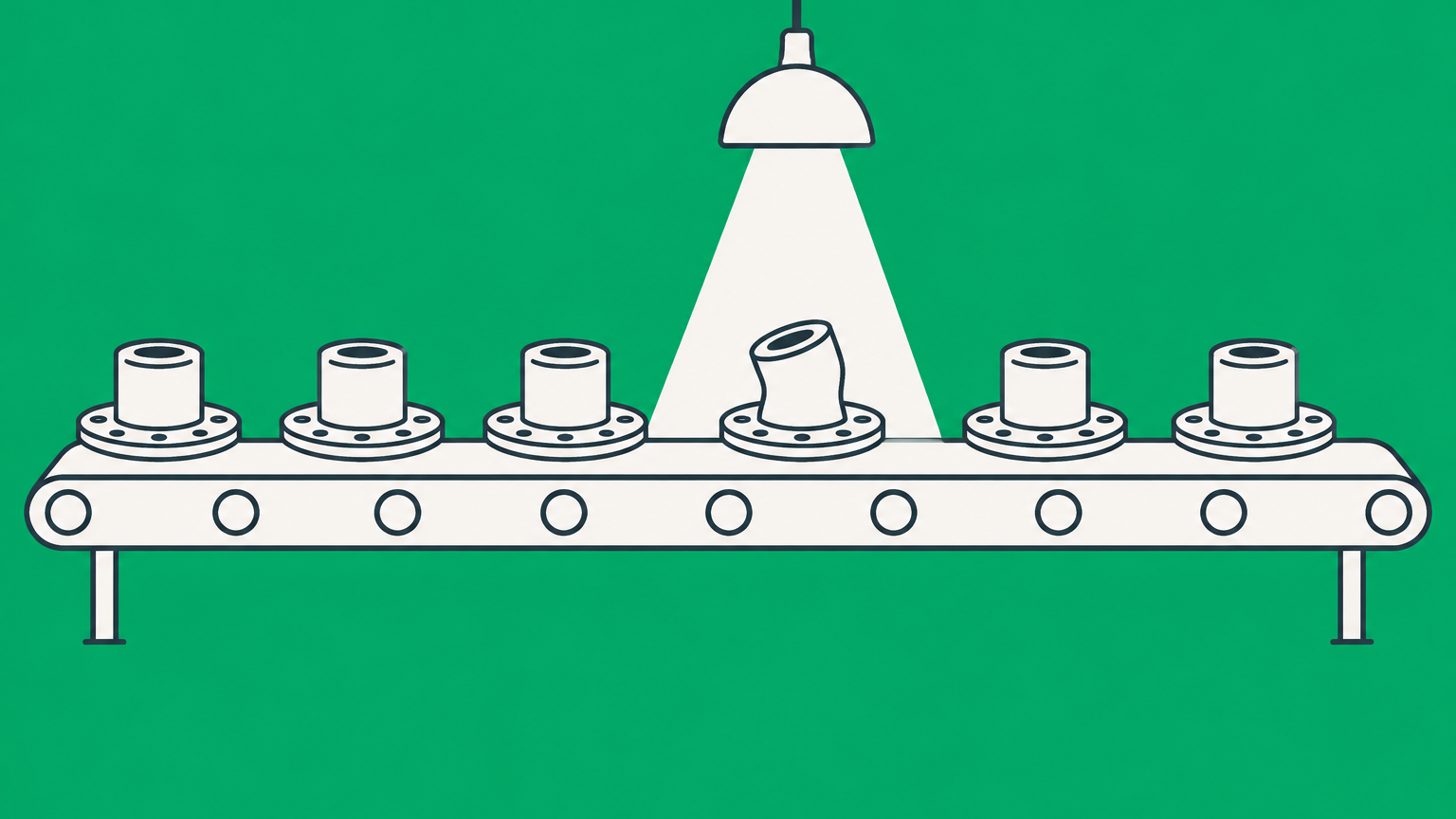
The manufacturing defect definition is a production-stage error that causes a finished product to depart from its intended design. The design itself may be sound, but the affected unit becomes unsafe or unsuitable because something went wrong while it was made, assembled, or inspected.
Key Takeaways
- A manufacturing defect arises when a product fails to match its intended design because of a production error.
- Common causes include contamination, improper assembly, missing components, faulty wiring, and unsuitable materials.
- Manufacturing defects differ from unsafe designs and inadequate instructions or warnings.
- Proving that a defect exists is not enough by itself. A claimant generally must connect the defect to an injury or other legally recognized loss.
- Potential claims may involve strict liability, negligence, or breach of warranty, depending on state law and the facts.
- Consumers should preserve the product, while manufacturers should maintain testing, inspection, and traceability records.
Manufacturing Defect Definition and Core Legal Meaning
A manufacturing defect exists when a particular product does not conform to the manufacturer's intended design or production specifications. The defining question is not whether engineers created a bad design. It is whether the finished item came off the production line differently from the product that was supposed to be made.
For example, assume a power tool's approved design calls for insulated internal wiring. If one unit contains exposed wiring because insulation was omitted during assembly, that unit may have a manufacturing defect. If every tool uses wiring that overheats even when properly assembled, the problem may instead involve the design.
A factory defect, manufacture defect, and production defect are often used informally as synonyms. In a legal claim, however, the specific cause matters. A cosmetic imperfection that does not affect safety, performance, value, or the product's promised characteristics may not support the same remedies as a dangerous defect that causes an injury.
Manufacturing defects often affect one item, one production run, or a limited batch rather than an entire product line. A broader problem can still be a manufacturing issue if the same production failure affected many units. For a deeper overview of the legal concept, see manufacturing defects and liability.
How Manufacturing Defects Occur and Common Examples
Manufacturing defects can arise at almost any point between receipt of raw materials and final packaging. A machine may be calibrated incorrectly, an employee may install a component improperly, or an inspection process may fail to identify an abnormal unit. Supplier problems can also introduce defective materials or components into an otherwise sound product.
Common categories and examples include:
- Contamination: Medication, food, cosmetics, or another product contains bacteria, chemicals, foreign particles, glass, or metal introduced during production.
- Incorrect assembly: A brake component, medical device, appliance, or machine is installed backward, left loose, or attached using the wrong fastener.
- Missing components: A vehicle lacks a required safety part, an appliance is missing insulation, or a product leaves the factory without a specified protective guard.
- Faulty wiring: Loose, crossed, or exposed wiring creates a risk of fire, overheating, electric shock, or equipment failure.
- Flawed materials: A product uses cracked, weakened, contaminated, or out-of-specification material even though its design requires suitable material.
What makes these manufacturing defects is the mismatch between the affected product and its intended design. If the manufacturer deliberately specified the allegedly dangerous material, the dispute may concern design rather than production. Businesses using third parties to make goods should clearly allocate production and quality responsibilities. The distinction between contract manufacturing and licensing can also affect operational control and contract risk.
Manufacturing Defects vs. Design and Warning Defects
Product liability law generally recognizes three broad defect categories: manufacturing defects, design defects, and warning or instruction defects. One incident can raise more than one theory. For example, a machine could contain a wrongly assembled guard and also lack adequate instructions about a separate hazard.
| Defect Type | When It Arises | Products Potentially Affected | Representative Example |
|---|---|---|---|
| Manufacturing defect | During material selection, fabrication, assembly, testing, or packaging | Often one unit or a limited batch, although a repeated production failure can affect many units | One appliance contains exposed wiring even though the design requires insulation |
| Design defect | When the product's specifications or planned configuration are created | Potentially every product made according to that design | A properly manufactured tool remains unstable because of its planned shape |
| Warning defect | When foreseeable risks are not addressed through adequate warnings or instructions | Products distributed with the same inadequate label, warning, or instructions | A chemical product omits necessary handling directions for a nonobvious hazard |
The distinction determines what the parties must investigate. A manufacturing claim often compares the failed unit with design specifications or properly made units. A design claim examines the planned product itself. A warning claim focuses on the content, clarity, placement, and adequacy of safety information. Manufacturers working through another business should address specifications, inspections, rejected goods, and responsibility for claims in a manufacturing license agreement or other production contract.
How to Prove a Manufacturing Defect
A person asserting a manufacturing defect generally needs evidence that the product differed from its intended design, that the difference existed before the product left the relevant defendant's control, and that the defect caused the claimed harm. The precise elements and burden of proof depend on applicable state law and the legal theory asserted.
Useful evidence may include:
- The product itself, preserved in its post-incident condition
- Photographs or videos of the product, accident location, packaging, and injuries
- Receipts, invoices, serial numbers, lot numbers, and purchase records
- Instructions, labels, warranties, advertisements, and product specifications
- Medical records, repair estimates, property records, and incident reports
- Comparable products showing how a properly made unit differs
- Manufacturing, supplier, inspection, testing, and quality-control documents
- Expert analysis concerning the failure and its likely cause
Do not repair, disassemble, discard, or return a suspected defective product before obtaining appropriate advice if an injury or serious loss occurred. Altering the item can make it harder for experts and opposing parties to determine what happened. Store it safely, restrict further use, and document its condition.
Sometimes the product is destroyed or the precise defect cannot be isolated. Depending on state law, circumstantial evidence of an abnormal malfunction may help establish a claim when other reasonable causes, such as misuse or major post-sale alteration, can be excluded. That possibility does not remove the need to prove causation and legally recognized damages.
Liability, Strict Liability, and Responsible Parties
A manufacturing defect claim may rely on strict product liability, negligence, breach of express warranty, or breach of implied warranty. Strict liability generally focuses on the defective condition of the product rather than requiring proof that the manufacturer acted carelessly. It does not mean that every manufacturer automatically owes compensation whenever a product fails.
The claimant still generally must establish the required elements, including a qualifying defect and a connection between that defect and the injury or loss. Negligence may focus on unreasonable conduct in production, training, supplier oversight, inspection, or testing. Warranty claims depend on the statements, promises, sales terms, disclaimers, and state rules that apply to the transaction.
Several businesses may have relevant roles. A component maker may have supplied a defective part. An assembler may have installed a sound part incorrectly. A finished-product manufacturer may have controlled specifications or inspections. A distributor or seller may also be involved under some state laws. Identifying a business in the supply chain does not establish that it is liable. Contracts, control, product changes, and jurisdiction-specific law must be examined.
If a suspected defect caused injury, property damage, or a dispute over responsibility, you can post your legal need on UpCounsel's marketplace. A product liability attorney can help preserve evidence, identify potentially responsible parties, seek manufacturing and inspection records, evaluate state-specific claims, and connect the defect to the alleged harm. Responses typically arrive within a day.
Consumer Steps, Claims, and Potential Remedies
After an incident, obtain necessary medical care and prevent anyone from using the product again. Preserve the item, packaging, accessories, instructions, proof of purchase, and communications with the seller or manufacturer. Write down when and where the incident occurred, how the product was being used, and who witnessed it. Photographs should capture both the product and the surrounding conditions.
You may also check official recall information and contact the manufacturer or seller, but avoid surrendering the only available product without understanding how it will be stored and inspected. Keep copies of reports, emails, shipping records, refund offers, and warranty communications. A refund or replacement process may not resolve a separate personal injury or property damage claim.
Potential remedies depend on the claim and state law. Recoverable losses may include medical expenses, lost income, property damage, and other damages recognized in the applicable jurisdiction. Warranty remedies may include repair, replacement, refund, or contract-based damages. Wrongful death claims may be available when a defective product causes a death, subject to state-specific requirements.
Finding a defect and proving a legal claim are separate questions. A defective product may cause no compensable harm, while an injury may result from misuse, alteration, poor maintenance, or another cause unrelated to production. Filing periods, proof requirements, defenses, and damages vary by state, so jurisdiction-specific rules should be checked promptly.
Preventing Manufacturing Defects Through Quality Control
Manufacturers can reduce production defects by converting design requirements into measurable material, assembly, and performance standards. Quality controls should address incoming materials, work in progress, finished products, packaging, and any outside supplier or contract manufacturer involved in production.
Practical measures include:
- Supplier controls: Approve suppliers, define material specifications, and inspect or test incoming components according to the product's risks.
- Process controls: Use documented assembly instructions, equipment settings, calibration schedules, and controls for production changes.
- Employee training: Train workers on assembly requirements, contamination controls, reporting procedures, and when to stop production.
- Inspection and testing: Test at appropriate production stages rather than relying only on a final visual inspection.
- Traceability: Track materials, components, production dates, facilities, and lots so affected products can be identified.
- Corrective action: Investigate failures, isolate nonconforming goods, identify root causes, and confirm that corrective measures work.
Records should show what standards applied, who completed inspections, what results were obtained, and how rejected products were handled. Certificates and trade documentation may serve different purposes from quality records, so businesses should understand the role of a certificate of manufacture without treating it as proof that every individual unit is defect-free.
Clear contracts also matter. They can assign testing duties, audit rights, documentation requirements, recall cooperation, indemnification, and procedures for handling rejected goods. These terms do not replace an effective quality system, but they can reduce uncertainty when a defective component or finished product enters the market.
Frequently Asked Questions
What Is Considered a Manufacturing Defect?
A product is generally considered to have a manufacturing defect when an unintended production variation makes it different from the approved design or specifications. Minor appearance differences do not necessarily create a product liability claim. The variation must be evaluated alongside the product's safety, promised performance, resulting harm, and the legal standards of the state governing the dispute.
What Are the 7 Types of Defects?
There is no universal legal list of seven product defects. Product liability law commonly groups defects into manufacturing, design, and warning categories. Quality-control systems may use seven or more operational categories, such as material, dimensional, assembly, cosmetic, electrical, contamination, and packaging defects, but those labels vary by industry and do not independently determine legal liability.
How Can You Prove a Manufacturing Defect if the Product Is Destroyed?
You may be able to use circumstantial evidence, although losing the product can significantly complicate the case. Witness accounts, photographs, videos, service histories, electronic data, similar incidents, recall records, and expert analysis may help reconstruct the failure. Courts apply different standards, and questions about why the product is unavailable can affect whether that evidence is sufficient.
What Are Some Examples of Manufacturing Defects in Components?
Examples include a cracked fastener installed in a machine, contaminated material used in medication, an improperly welded vehicle part, or a battery cell assembled outside required specifications. A component defect can damage a larger finished product, but responsibility depends on where the defect originated, who controlled integration and testing, and whether later changes contributed to the failure.
Can a Store Sell Factory Defect Items?
A store may sell some imperfect goods when they remain lawful and safe and the seller accurately discloses their condition. Labeling an item as a factory second does not excuse the sale of an unreasonably dangerous product or eliminate applicable warranties and consumer protections. Rules can differ for used products, recalled goods, food, medicine, vehicles, and other regulated categories.


