IP portfolio management is the process of organizing, evaluating, protecting, and using a company's intellectual property in support of its business goals. A practical system helps you control costs, preserve valuable rights, identify protection gaps, and make better decisions about patents, trademarks, copyrights, and trade secrets.
Key Takeaways
- An IP portfolio is the collection of intellectual property assets and rights owned, used, licensed, or developed by a business.
- Effective management connects each asset to a product, market, revenue source, competitive advantage, or other business objective.
- A reliable process covers inventory, ownership review, analysis, prioritization, protection, deadline tracking, monitoring, and reassessment.
- An IP audit should document legal status, chain of title, key agreements, jurisdictions, costs, deadlines, and business relevance.
- Spreadsheets may work for a small portfolio, while larger or international portfolios may require specialized software and stronger access controls.
- Patent-heavy and global portfolios require additional attention to filing strategy, maintenance costs, local rules, and jurisdiction-specific deadlines.
What Is IP Portfolio Management?
An intellectual property portfolio is a collection of intangible assets and related legal rights. It may include patents, patent applications, trademarks, copyrights, trade secrets, domain-related brand assets, licenses, and contractual rights. A portfolio can cover an entire company, one product family, a geographic market, or a particular technology.
Intellectual property portfolio management is the structured process used to oversee that collection. It asks what the business owns, who created it, which rights have been registered, where protection applies, what each asset costs, and how the asset supports the company's plans. It also assigns responsibility for filings, renewals, internal controls, monitoring, and strategic review.
Several related terms have different scopes. Intellectual property management is the broadest concept. It can include invention capture, brand clearance, confidentiality practices, employee agreements, licensing, disputes, and portfolio oversight. IP asset management focuses on treating individual rights and related information as managed business assets. IP portfolio analysis is the evaluation stage, where the company compares assets, risks, costs, and commercial relevance. Portfolio management combines these activities into an ongoing system.
The objective is not simply to accumulate registrations. Each asset should have a reason to exist. It might protect a current product, preserve a market position, support a future launch, strengthen a negotiation, or safeguard confidential know-how. A broader intellectual property business strategy can help connect these legal decisions to growth, competition, and product planning.
How to Build an IP Portfolio Management Cycle
A repeatable cycle gives legal, product, finance, and leadership teams a shared process. Start with the following steps, then repeat them as the company, products, and markets change:
- Create an inventory. Record registered rights, pending applications, unregistered works, trade secrets, licenses, assignments, and IP developed by employees, founders, contractors, or collaborators.
- Confirm ownership and status. Review inventorship or authorship records, assignments, employment terms, contractor agreements, license restrictions, registrations, and pending proceedings. Check official records rather than relying only on internal labels.
- Connect assets to the business. Identify the product, service, brand, process, market, or research program associated with each item. Record whether it supports current operations or a documented future plan.
- Analyze and prioritize. Compare commercial importance, competitive value, geographic coverage, cost, remaining term, enforceability concerns, and potential future use.
- Make protection decisions. Decide which innovations or brands require applications, registrations, confidentiality controls, contractual protection, or further legal review.
- Track deadlines and responsibilities. Assign an owner for each task and maintain a reliable docket for filings, responses, renewals, maintenance payments, evidence, and agreement obligations.
- Monitor and reassess. Watch relevant markets and third-party filings, review possible conflicts, and revisit the portfolio after product changes, transactions, expansion, or changes in strategy.
Responsibility should not rest with one department alone. Engineers and product teams identify innovation. Marketing teams understand brand use. Human resources and operations manage personnel records and confidentiality procedures. Finance tracks costs and transaction value. Legal counsel evaluates ownership, protection, and risk. Companies building their first formal process can also use an IP strategy for startups to coordinate early filings with hiring, fundraising, and product launches.
How to Audit an Intellectual Property Portfolio
An IP audit establishes what the company has, what it controls, and what needs attention. Begin by collecting information from legal files, product teams, research records, marketing systems, employment files, vendor agreements, and transaction documents. Do not assume that a registration list is a complete inventory. Valuable software, content, confidential methods, or licensed technology may sit outside that list.
For each asset, record the following fields:
- The asset name, description, and type of IP
- The legal owner and any prior owner
- The related product, service, brand, process, or project
- Countries or other jurisdictions involved
- Application, registration, pending, licensed, or internal status
- Filing, renewal, maintenance, expiration, and agreement dates
- Assignments, licenses, coexistence terms, security interests, and collaboration agreements
- The responsible employee, department, outside counsel, or vendor
- Past and expected filing, maintenance, monitoring, and enforcement costs
- Current business use and expected future relevance
Then test the records. Compare internal ownership information with the applicable official registry. Confirm that signed assignments and other chain-of-title documents match the parties and assets shown in the inventory. For trade secrets, review who has access, where information is stored, and which confidentiality measures apply. For licensed assets, identify restrictions on territory, field of use, sublicensing, transfer, and termination.
Document open questions instead of filling gaps with assumptions. The audit report should identify missing agreements, uncertain ownership, inconsistent records, upcoming decisions, and assets that no longer support a business purpose. It should also assign follow-up work and an accountable person.
If an audit reveals uncertain ownership, missing assignments, disputed rights, approaching deadlines, cross-border assets, or protection gaps around an important product, you can post your legal need on UpCounsel's marketplace. An IP attorney can review chain-of-title documents and agreements, confirm asset status, identify legal risks, and help create a prioritized protection and maintenance plan. Responses typically arrive within a day.
IP Portfolio Analysis and Prioritization
IP portfolio analysis turns an inventory into decisions. Avoid assigning value based only on filing costs, the number of registrations, or the technical quality of an invention. A legally significant right may have limited business relevance, while an unregistered brand or carefully protected trade secret may be central to operations.
Evaluate each asset through documented considerations rather than an unsupported scoring formula:
- Current use: Is the asset connected to a product, service, brand, or process that the company currently uses?
- Competitive importance: Does it protect a meaningful point of differentiation or reduce the ability of competitors to copy an important feature?
- Geographic fit: Does protection cover markets where the company sells, manufactures, sources, licenses, or plans to expand?
- Cost: Are upcoming prosecution, renewal, maintenance, monitoring, and enforcement costs proportionate to expected use?
- Legal strength and risk: Are there ownership questions, narrow coverage, prior agreements, validity concerns, or practical enforcement problems requiring review?
- Future role: Could the asset support a planned product, partnership, financing, licensing program, sale, or defensive position?
Place assets into decision categories such as maintain, strengthen, investigate, license, sell, or allow to lapse. The category should trigger a specific next action, responsible person, and review date. Before abandoning a right, examine agreements, financing terms, license obligations, pending transactions, and effects on related assets.
Valuation is related to analysis but serves a different purpose. Cost, market, and income approaches may help with transactions or financial decisions, depending on the circumstances. For a closer look at how intangible rights contribute to company value, see intellectual property asset valuation and strategy.
IP Portfolio Example and Asset-Specific Records
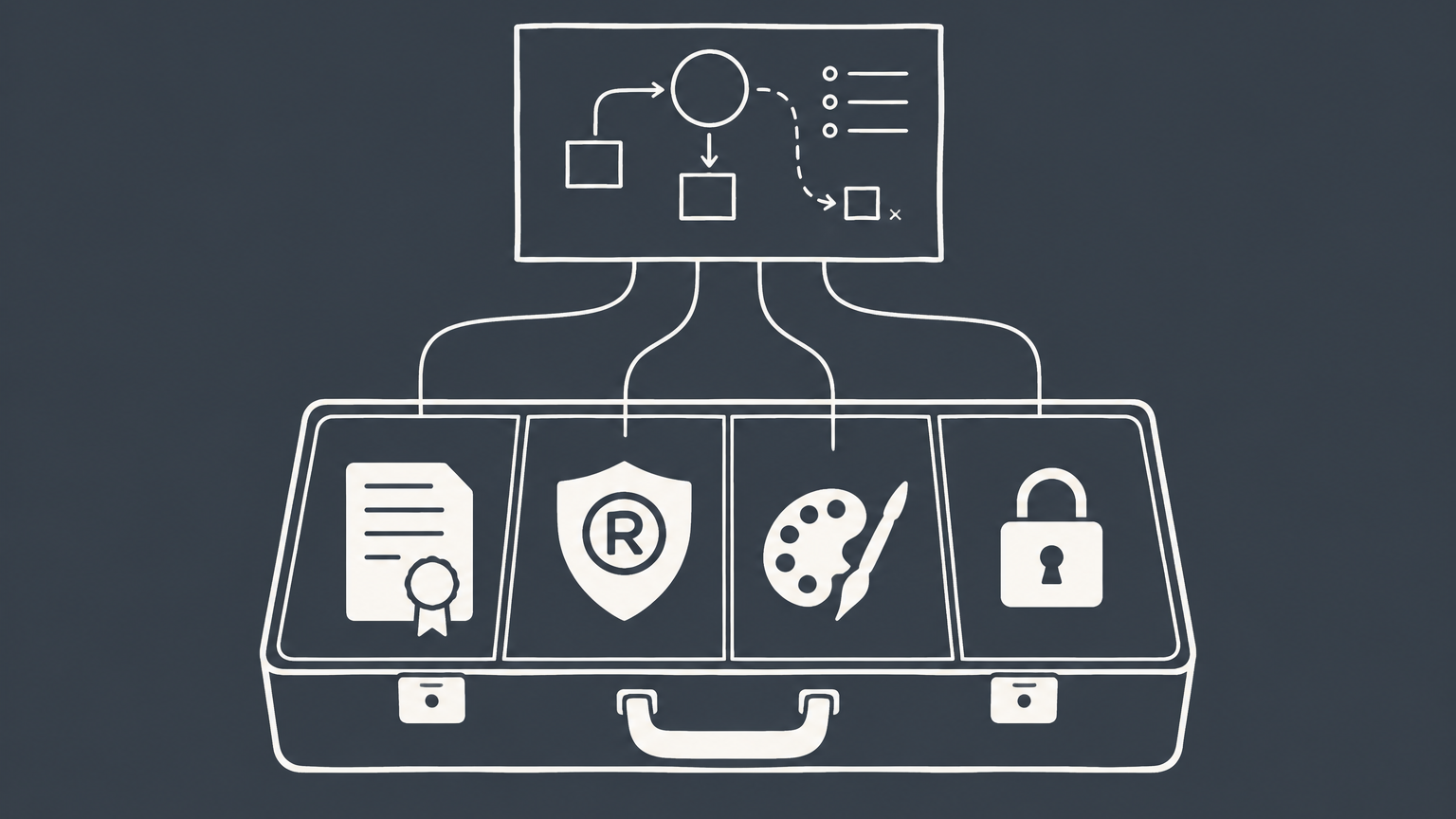
A software company might maintain patents for technical features, trademarks for its company and product names, copyrights covering source code and documentation, and trade secrets covering internal methods or nonpublic data. These assets may protect the same product, but they require different records, controls, and legal review.
| IP Type | What to Inventory | Records to Monitor | Teams Often Involved | Details to Verify |
|---|---|---|---|---|
| Patents | Inventions, applications, issued patents, related families, and licenses | Inventor records, prosecution files, maintenance events, jurisdictions, and product mapping | Engineering, research, product, finance, and legal | Ownership, inventorship, status, scope, deadlines, and applicable official records |
| Trademarks | Names, logos, slogans, product brands, registrations, applications, and licenses | Use records, specimens, renewals, watch results, markets, and approved brand forms | Marketing, sales, product, compliance, and legal | Owner, goods and services, territory, status, use requirements, and current deadlines |
| Copyrights | Software, websites, designs, photographs, videos, manuals, advertising, and registrations | Creation records, versions, author information, assignments, licenses, and publication details | Engineering, creative, marketing, publishing, and legal | Authorship, work status, ownership, permissions, registration details, and licensed material |
| Trade Secrets | Confidential formulas, methods, code, data, processes, strategies, and know-how | Access lists, confidentiality agreements, security controls, disclosures, and exit procedures | Security, operations, human resources, research, leadership, and legal | Ownership, confidentiality obligations, authorized access, protective measures, and governing agreements |
The table is an operating framework, not a substitute for jurisdiction-specific advice. Legal status, filing requirements, duration, and preservation rules vary by right and location. Verify those details through the relevant official authority. Also distinguish owned IP from licensed IP. A company may depend heavily on technology or content that it has permission to use but does not own.
Choosing IP Portfolio Management Software or Spreadsheets
A spreadsheet may be enough when a company has a small number of assets, operates in few jurisdictions, and has simple deadlines. It can provide a low-cost inventory with customizable fields. Its weaknesses become more serious as the portfolio grows. Manual updates, duplicate versions, limited permissions, and inconsistent reminders can undermine the reliability of the record.
IP portfolio management software can centralize documents, asset families, status information, deadlines, costs, reports, and assignments. Some systems also support workflow management or connections with finance, document, and identity tools. Software does not determine legal status by itself. Your team must still verify data, maintain procedures, and assign responsibility for each action.
Compare tools using practical requirements:
- Portfolio size: Consider current assets and expected growth, not only today's inventory.
- Jurisdictions: Determine whether the system can organize related rights and local counsel across multiple countries.
- Deadline complexity: Identify the reminders, escalation rules, review steps, and audit history your team needs.
- Collaboration: Check how employees, executives, outside counsel, and vendors can contribute without overwriting controlled data.
- Reporting: Confirm that the system can show costs, status, product coverage, geographic coverage, and upcoming decisions.
- Access controls: Restrict sensitive invention records, legal communications, agreements, and trade secret information.
- Integration: Assess compatibility with document storage, billing, finance, identity, and other approved systems.
Assign a data owner before selecting a tool. A sophisticated platform will not fix incomplete records or unclear accountability. Establish naming conventions, required fields, update procedures, access rules, and periodic quality checks first.
Patent Portfolio Management and Ongoing Maintenance
Patent portfolio management requires close coordination among technical teams, business leaders, and counsel. Group applications and issued patents by technology, product, patent family, jurisdiction, and business purpose. This reveals duplicate coverage, geographic gaps, costly families, and patents that no longer align with active products.
Review each family at meaningful decision points. Consider the technology's expected use, product roadmap, competitive relevance, geographic plans, remaining term, prosecution status, maintenance costs, and known legal concerns. A pending application may justify further investment if it protects an important launch. Another may warrant narrower spending if the underlying project has ended. Counsel should review legal consequences before the company abandons an application or allows a patent to lapse.
Maintenance also includes more than payments and renewals. Teams should preserve invention and assignment records, monitor relevant competitor activity, evaluate potential conflicts, and address product changes that may require new filings. Before launching into a market, the company may need a separate freedom-to-operate analysis. Owning patents does not itself establish freedom to use a product without implicating another party's rights.
Revenue decisions should follow business and legal analysis. Licensing, sale, financing, and other monetization strategies are separate from basic portfolio administration. They may involve valuation, tax, contractual, regulatory, and ownership questions. Review intellectual property licensing terms and strategies when granting another party rights, or consider dedicated IP monetization strategies when evaluating broader revenue options.
Global IP Portfolio Management
Global IP portfolio management combines a centralized inventory with country-specific legal review. Centralization gives the company a consistent view of ownership, products, costs, agreements, deadlines, and responsible personnel. Local review accounts for differences in availability, registration, use, maintenance, enforcement, and transfer rules.
Start by mapping each asset to the countries where the company currently sells, manufactures, develops, licenses, or faces meaningful competition. Add documented expansion plans. Protection should follow business priorities rather than an assumption that every asset requires filing in every possible market.
For each jurisdiction, verify:
- The recorded owner and chain of title
- The right's current application, registration, or maintenance status
- Upcoming filing, response, renewal, use, or payment requirements
- Local agreements, licenses, security interests, and restrictions
- Translation, evidence, recordation, and local counsel needs
- Practical monitoring and enforcement considerations
The World Trade Organization's intellectual property materials provide an overview of intellectual property rights in the international trade framework. They do not replace the instructions of national or regional authorities. Confirm current requirements with the applicable official authority and qualified counsel.
Multinational companies often use central policies for reporting inventions, approving filings, controlling access, and escalating disputes. They then rely on local or regional advice for country-specific action. Keep local records synchronized with the central inventory, and document why the business enters, maintains, reduces, or exits each jurisdiction. This creates a reviewable strategy instead of a collection of disconnected filings.
Frequently Asked Questions
What Is Global IP Portfolio Management?
Global IP portfolio management is coordinated oversight of intellectual property held or used across multiple jurisdictions. It combines centralized reporting and decision-making with local verification of ownership, registration, deadlines, contractual restrictions, and enforcement options. The approach helps a company apply consistent business priorities while accounting for rules that differ among countries and types of intellectual property.
How Do You Manage a Portfolio of Trademarks and Patents?
Manage trademarks and patents through one controlled inventory while maintaining separate workflows for each right. Link related rights to products and markets, assign responsible personnel, and document decisions. Trademark reviews should account for brand use and market coverage, while patent reviews should address invention records, technical scope, patent families, prosecution, and maintenance choices.
What Is an IP Portfolio?
An IP portfolio is the organized collection of intellectual property that a business owns, controls, licenses, or is developing. It can include registered and unregistered rights, applications, confidential information, and relevant contracts. The portfolio may cover the whole organization or be grouped around a product, technology, brand, business unit, or geographic market.
What Is IP Management?
IP management is the broader business and legal discipline used to identify, secure, control, maintain, and use intellectual property. Its work can begin before a formal right exists, such as when employees report an invention or a company selects a brand. It can also cover contracts, policies, training, disputes, transactions, and confidential information controls.
How Can a Business Audit Its IP Portfolio?
A business can audit its portfolio by interviewing relevant teams, collecting legal and operational records, and reconciling them with official sources. The review should also look beyond formal registrations for overlooked creative works, confidential methods, inbound licenses, former employee contributions, and collaboration results. Record unresolved issues separately so they receive legal or operational follow-up.
What Are the Seven Types of Intellectual Property Rights?
There is no single universal list of exactly seven IP rights for every legal system. Common categories include patents, trademarks, copyrights, trade secrets or undisclosed information, industrial designs, geographical indications, and rights concerning plant varieties or certain specialized subject matter. Available protection and terminology depend on the jurisdiction, so businesses should check the relevant official authority.


